Servo Voltage Stabilizer vs Static Voltage Stabilizer — Complete Technical Comparison
Published by Hindustan Stabilizers Technical Team | August 2026 | 10 min read
When specifying a voltage stabilizer for an industrial or commercial application, the most common question buyers ask is: "Should I choose a Servo Voltage Stabilizer or a Static Voltage Stabilizer?" Both technologies deliver regulated output voltage, but their working principles, performance characteristics, and ideal use cases differ significantly. This guide provides a complete technical comparison to help you make the right choice for your specific application.
How a Servo Voltage Stabilizer Works
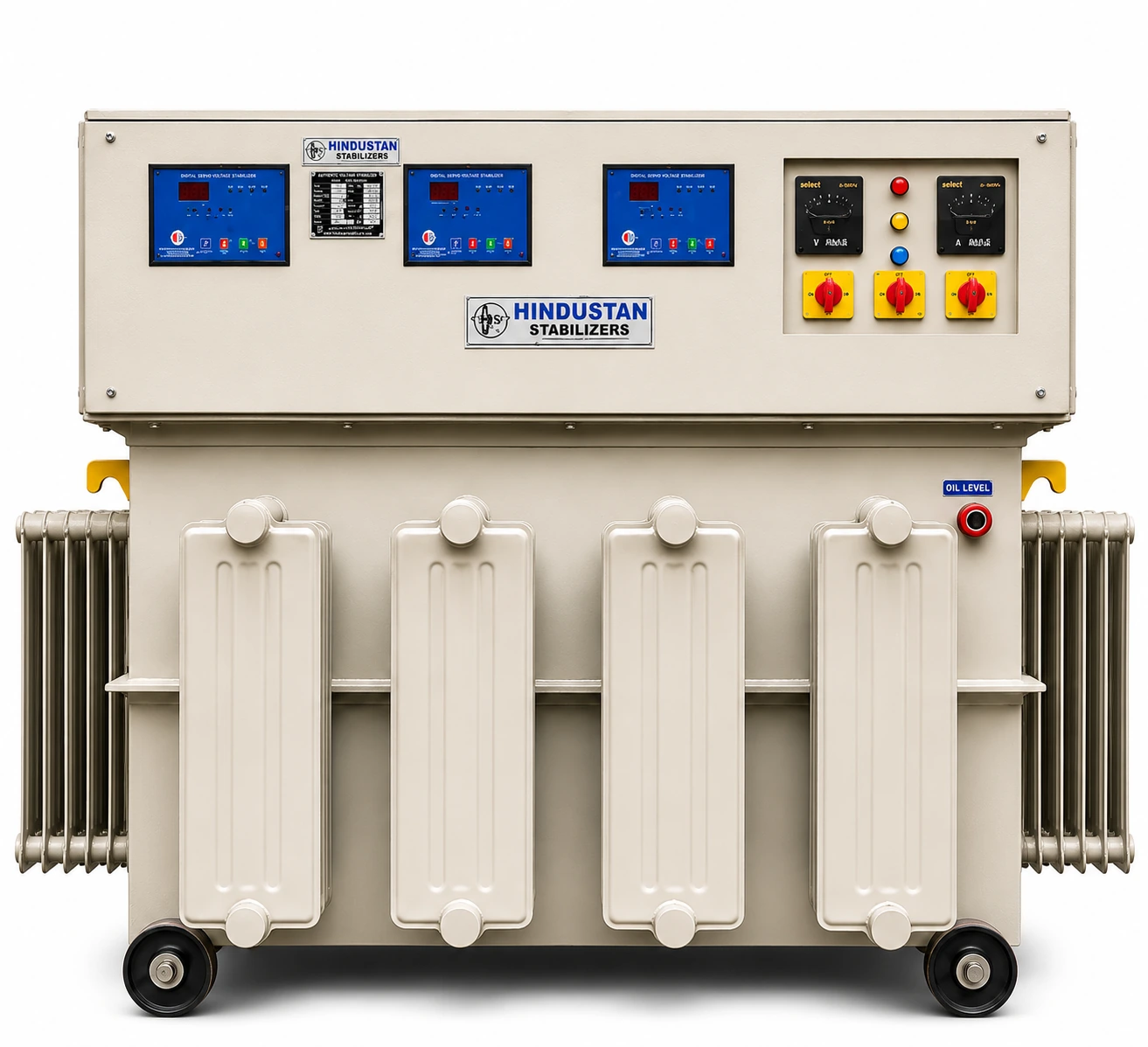
A Servo Voltage Stabilizer uses an electromechanical closed-loop control system. A servo motor drives a variable autotransformer (variac), which adds or subtracts voltage to the supply to maintain a constant output. The control circuit continuously samples the output voltage and commands the servo motor to rotate in the corrective direction. Correction speed is typically 10V to 15V per second for standard models, and up to 30V per second for high-speed variants.
Because the variac adjusts continuously and smoothly (without switching), the output waveform is a near-perfect sine wave with very low harmonic distortion — typically less than 2% THD. This makes servo stabilizers ideal for loads that are sensitive to waveform quality, such as CNC machines, printing presses, and medical equipment.
How a Static Voltage Stabilizer Works
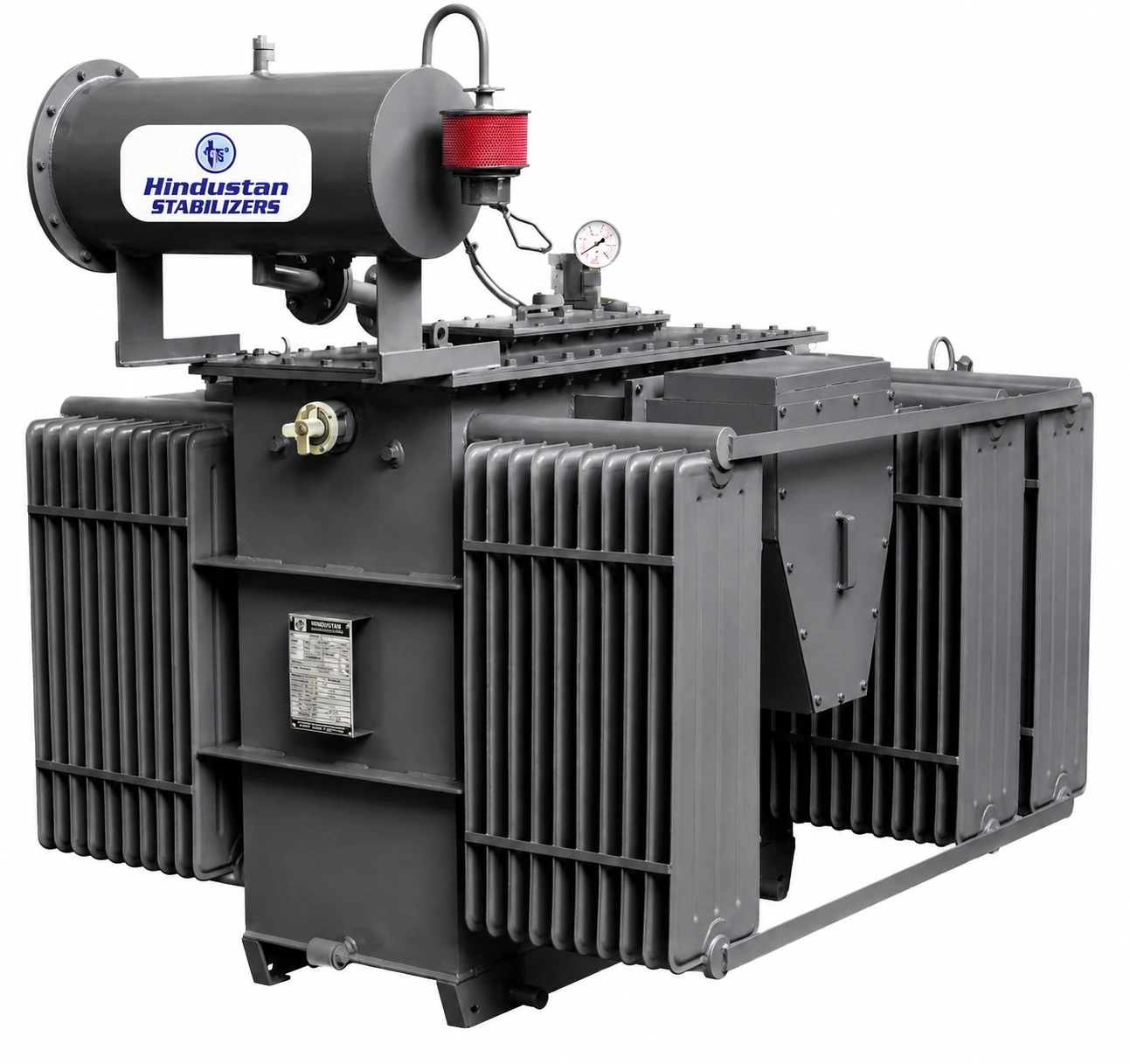
A Static Voltage Stabilizer (SVS) uses solid-state switching devices — typically Silicon Controlled Rectifiers (SCRs) or Insulated Gate Bipolar Transistors (IGBTs) — to electronically switch between taps on a series boost or buck transformer. Because no mechanical motor is involved, switching happens within one half-cycle of the mains supply (approximately 10 milliseconds at 50 Hz), making static stabilizers dramatically faster at correcting sudden voltage changes.
The limitation of tap-switching is that output voltage regulation occurs in discrete steps. A typical 8-tap static stabilizer may have a voltage resolution of ±3% to ±5% per step. High-end SVS units with 16 or more taps can achieve ±1% to ±2% step resolution, but the hardware cost increases significantly. There is also some waveform distortion during each switching event.
Detailed Specification Comparison
| Parameter | Servo Voltage Stabilizer | Static Voltage Stabilizer |
|---|---|---|
| Correction Speed | 10–30 V/sec (mechanical) | Near instantaneous (1 cycle = ~20ms) |
| Output Regulation Accuracy | ±1% to ±3% (continuously variable) | ±3% to ±5% (step-based, depends on tap count) |
| Output Waveform Quality | Excellent — smooth, near-perfect sine wave | Moderate — brief distortion during tap switching |
| Input Voltage Range (typical) | 180V–280V (1-phase), 300V–470V (3-phase) | 150V–270V (1-phase), 270V–470V (3-phase) |
| Efficiency at Full Load | 97%–98.5% | 96%–98% (higher losses in SCR/IGBT devices) |
| Harmonic Distortion (THD) | <2% (near zero during steady state) | 3%–8% (spikes during switching) |
| Moving Parts | Yes — servo motor, carbon brushes, variac | No mechanical moving parts |
| Maintenance Requirement | Periodic carbon brush and variac inspection | Minimal — no moving parts; check SCRs/IGBTs |
| Noise Level | Low hum (motor noise during correction) | Near silent |
| Capacity Range | 1 kVA to 2000+ kVA | 5 kVA to 500 kVA (standard) |
| Upfront Purchase Cost | Lower for same kVA | Higher (solid-state devices are expensive) |
| Reliability / MTBF | Excellent (carbon brush is serviceable) | Excellent (no brushes, but SCR failure is costly) |
| Overload Capacity | Good (motor can sustain moderate overloads) | Limited (SCRs are sensitive to overloads and surges) |
| Suitability for CNC Machines | Ideal (±1% accuracy, clean waveform) | Acceptable if high tap-count unit is used |
| Suitability for Printing Presses | Excellent | Good (if correction speed is adequate) |
| Suitability for Pharmaceutical Plants | Excellent (continuous operation, clean output) | Good |
| Suitability for Sudden Load Changes | Moderate (servo motor speed limit) | Excellent (near-instantaneous correction) |
When to Choose a Servo Voltage Stabilizer
A Servo Voltage Stabilizer is the preferred choice in the following situations:
- The load is voltage-sensitive but not speed-sensitive — CNC machines, pharmaceutical equipment, printing presses
- You need ±1% regulation accuracy at the lowest possible cost per kVA
- The installation is large (above 100 kVA), where servo technology is more economical than static
- Input voltage fluctuations are slow and gradual (typical of distribution grid fluctuations in India)
- Clean, low-harmonic output waveform is essential for the connected load
- Budget is a primary constraint — servo stabilizers are significantly cheaper at the same kVA rating
- Local AMC and servicing capability is important — servo stabilizers are widely serviceable across India
When to Choose a Static Voltage Stabilizer
A Static Voltage Stabilizer is the better choice in these situations:
- The load requires near-instantaneous voltage correction — e.g. thyristor-controlled drives, sensitive power electronics
- Voltage fluctuations are rapid and occur multiple times per second (e.g. near arc furnaces or heavy motor switching)
- Completely silent operation is mandatory (e.g. recording studios, certain lab environments)
- The installation environment is very dusty, humid, or corrosive, making servo motor maintenance difficult
- Zero mechanical maintenance is a hard requirement (remote location, difficult access)
Verdict: Which is Better for Indian Industrial Use?
For the overwhelming majority of industrial applications in India — including CNC machines, pharmaceutical plants, printing presses, hospitals, textile mills, and data centers — a Servo Voltage Stabilizer is the better and more economical choice. The typical voltage fluctuation pattern on Indian distribution grids is slow and gradual, which plays to the servo stabilizer's strengths. The servo's high accuracy, clean waveform, lower cost, wide availability of spares, and proven 30+ year track record make it the dominant technology for B2B industrial buyers in India.
Static Voltage Stabilizers are the right choice for specific niche applications where extremely fast correction or zero mechanical maintenance is non-negotiable. For most buyers, the premium cost of a static stabilizer is not justified by a meaningful improvement in performance for their specific application.
Need Help Deciding? Talk to Our Engineers
Hindustan Stabilizers has been manufacturing both Servo and Static Voltage Stabilizers since 1995. Share your load details, application type, and environment — our technical team will recommend the right solution for your requirement at no cost.
Get Free Consultation View Servo StabilizersQuick Verdict
- CNC, Pharma, Printing: Servo
- Large capacity (>100 kVA): Servo
- Budget-conscious: Servo
- Near-instant correction: Static
- Zero maintenance: Static
- Silent operation: Static