Copper vs Aluminium Winding in Voltage Stabilizers — Why the Choice Matters More Than You Think
Published by Hindustan Stabilizers Technical Team | August 2026 | 9 min read
When comparing servo voltage stabilizers from different manufacturers, many buyers focus almost entirely on capacity (kVA) and regulation accuracy (±1% or ±3%). The winding material — copper or aluminium — is often overlooked. This is a costly mistake. The choice of winding conductor fundamentally determines the stabilizer's energy efficiency, heat generation, service life, weight, and long-term total cost of ownership.
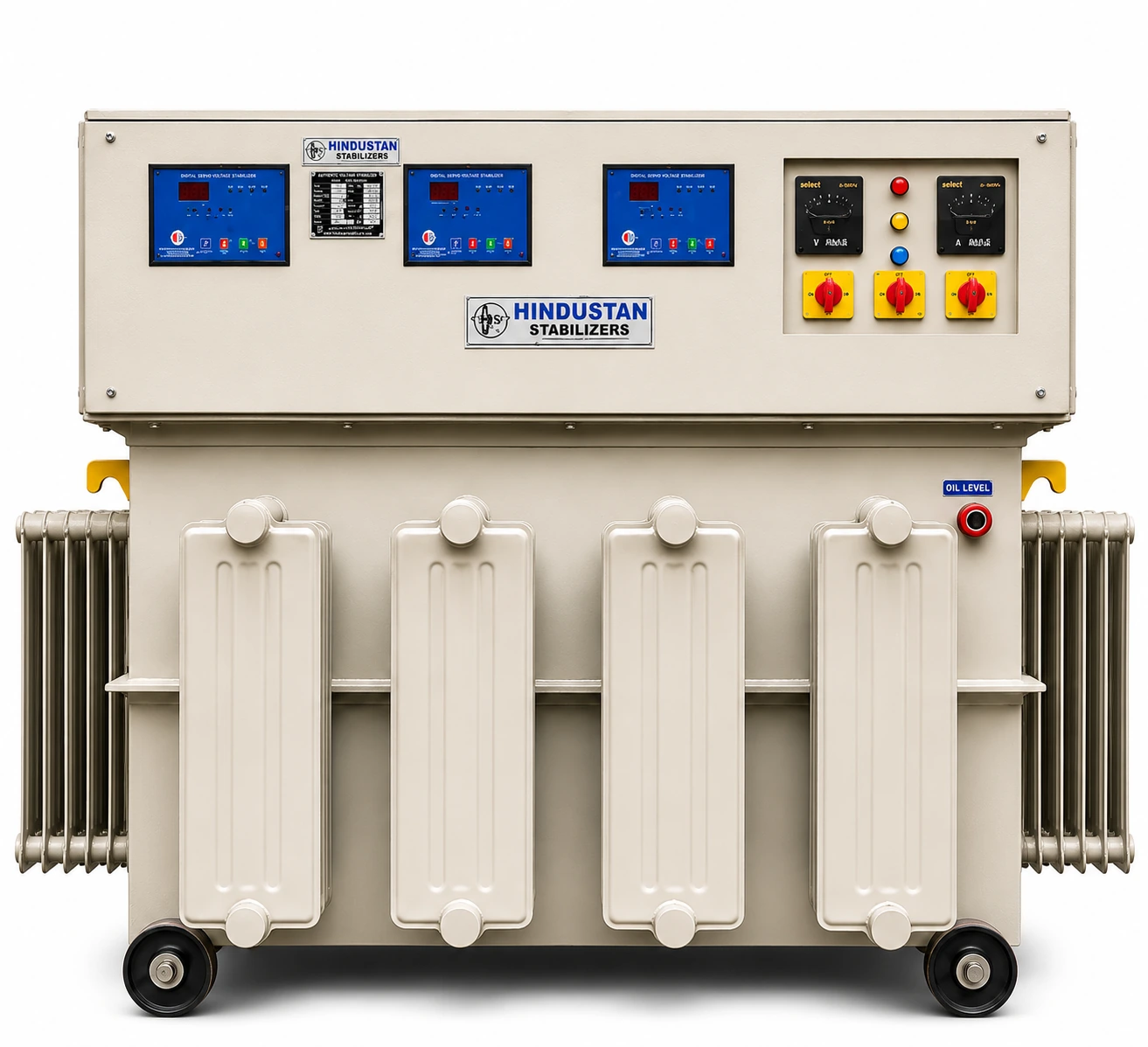
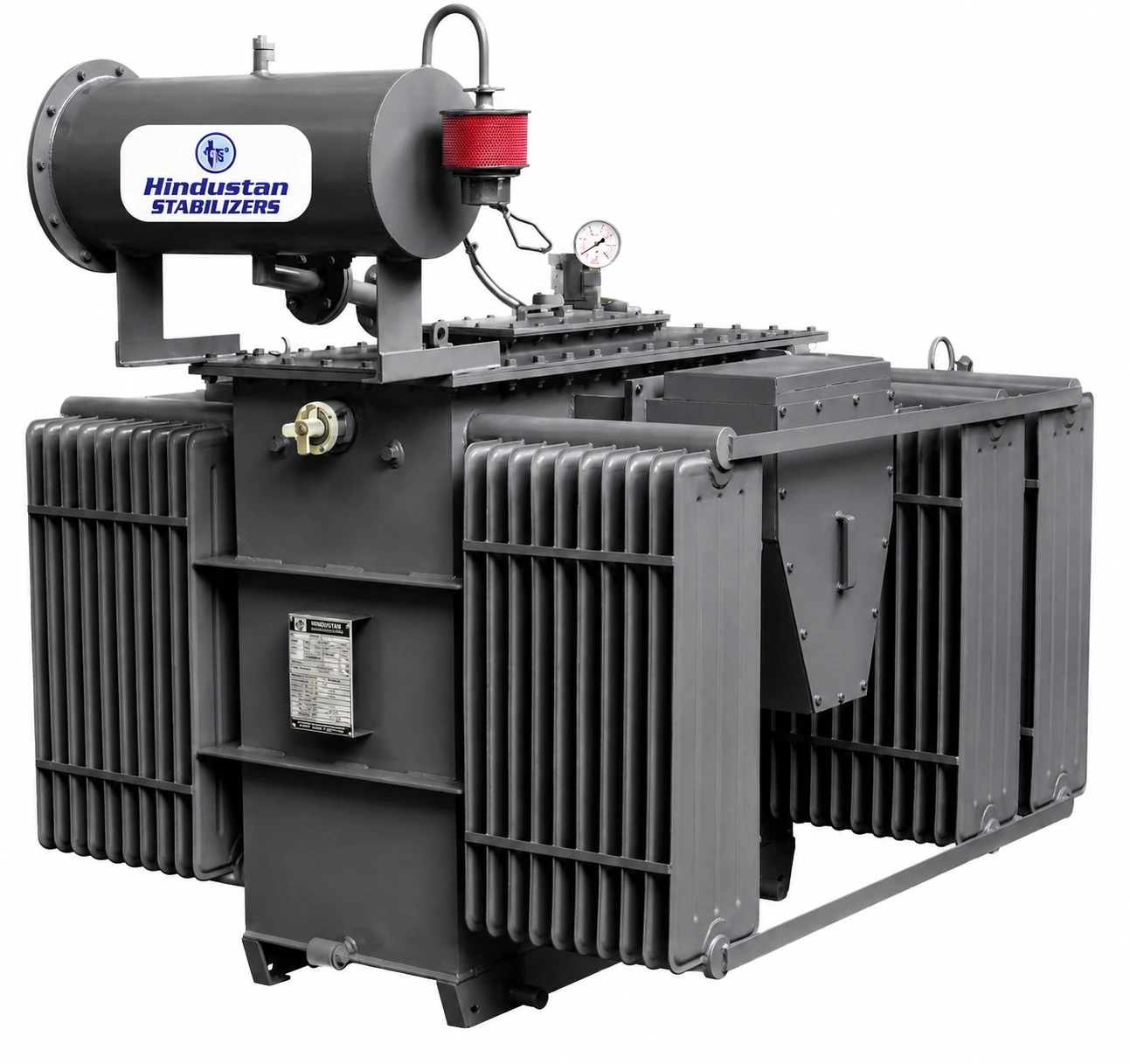
At Hindustan Stabilizers, all our servo voltage stabilizers, isolation transformers, and power transformers use 100% copper windings. This article explains exactly why we insist on copper and what it means for your investment.
The Fundamental Physics: Resistivity
The electrical resistivity of a conductor determines how much power it wastes as heat when current flows through it. Lower resistivity means less energy wasted and less heat generated for the same current.
| Property | Copper (Cu) | Aluminium (Al) |
|---|---|---|
| Electrical Resistivity (at 20°C) | 1.68 × 10⁻⁸ Ω·m | 2.82 × 10⁻⁸ Ω·m |
| Resistivity vs Copper | Baseline | ~68% higher than copper |
| Electrical Conductivity | 100% (IACS reference) | ~61% of copper |
| Thermal Conductivity | 401 W/(m·K) | 237 W/(m·K) |
| Melting Point | 1,085°C | 660°C |
| Tensile Strength (annealed) | ~200–250 MPa | ~75–100 MPa (2–3× weaker) |
| Coefficient of Thermal Expansion | 17 × 10⁻⁶ /K | 23.1 × 10⁻⁶ /K (36% more) |
| Density | 8,960 kg/m³ | 2,700 kg/m³ (3.3× lighter) |
The critical insight: to achieve the same DC resistance (and thus the same copper loss) in a winding, an aluminium conductor must be approximately 61% larger in cross-sectional area than an equivalent copper conductor. This means an aluminium-wound transformer is physically larger for the same electrical rating — partly negating the weight advantage.
Energy Efficiency: Where Real Money is Lost
The winding losses in a transformer or stabilizer (called "copper losses" or I²R losses) are directly proportional to the winding resistance. Because aluminium has 68% higher resistivity than copper, an aluminium-wound stabilizer of the same kVA rating generates significantly higher I²R losses at the same current.
For a continuously operating industrial stabilizer running 24 hours a day, 6 days a week, even a 0.5% difference in efficiency translates to thousands of rupees in additional electricity cost per year. For a 100 kVA stabilizer running at 80% load, a 1% efficiency difference results in approximately 700–800 kWh of additional energy waste per month.
Heat Generation and Insulation Life
Higher winding resistance in aluminium-wound stabilizers generates more heat for the same load current. Heat is the primary enemy of transformer and stabilizer winding insulation. The relationship between insulation temperature and service life follows Arrhenius' Law:
"For every 10°C rise in operating temperature above design limit, transformer insulation life is halved."
An aluminium-wound stabilizer operating at a 10°C higher winding temperature than a copper-wound equivalent of the same capacity will have approximately half the insulation service life. For a stabilizer expected to last 15–20 years in continuous industrial operation, this is a critical difference.
Mechanical Strength and Thermal Cycling Durability
Copper is 2 to 3 times mechanically stronger than aluminium. In a transformer or stabilizer, the windings experience electromagnetic forces during load changes and fault currents. Copper windings withstand these forces far better, maintaining their geometric form over time. Aluminium windings, being weaker and having a higher coefficient of thermal expansion, are more susceptible to physical deformation from thermal cycling — the repeated heating and cooling during each duty cycle.
In high-cycle applications like pharmaceutical clean rooms, textile mills, and CNC machine shops — where the stabilizer cycles between load and no-load many times per shift — copper's superior mechanical durability directly translates to longer service intervals and fewer winding failures.
Full Comparison: Copper vs Aluminium Wound Stabilizers
| Factor | Copper Winding | Aluminium Winding |
|---|---|---|
| I²R (Copper) Losses | Lower (reference) | ~40–60% higher for same kVA |
| Efficiency at Full Load | Higher (97.5%–99%) | Lower (96%–97.5%) |
| Heat Generation at Same Load | Lower | Higher |
| Winding Insulation Life | Longer (lower operating temperature) | Shorter (higher heat, thermal stress) |
| Mechanical Strength | Excellent (200–250 MPa) | Good but lower (75–100 MPa) |
| Thermal Expansion Stress | Lower | Higher (36% more expansion/cycle) |
| Physical Size for Same kVA | More compact | Larger (needs larger conductor to compensate) |
| Weight | Heavier (copper is dense) | Lighter |
| Upfront Material Cost | Higher (copper is ~4× the price of Al) | Lower |
| Total Cost of Ownership (10 years) | Lower (energy savings + longer life) | Higher (energy waste + earlier replacement) |
| Overload / Short-circuit Withstand | Excellent | Good (risk of deformation under high fault currents) |
| Joinability & Repairability | Easy to solder, weld, and repair | More difficult (requires special processes) |
| Contact Resistance at Terminals | Stable over time | Tends to oxidize (aluminium oxide is insulating) |
| Service Life in Continuous 24x7 Duty | 15–25 years | 10–15 years (typical) |
| Recommended for Industrial 24x7 use | Yes — strongly preferred | Suitable for light-duty or cost-constrained projects |
Why Cheap Stabilizers Often Use Aluminium
The primary reason some manufacturers use aluminium windings is straightforward: aluminium costs approximately one-quarter to one-third the price of copper by weight. A manufacturer can produce a lower-priced stabilizer using aluminium windings while advertising the same kVA rating and nominal regulation accuracy. The inferior efficiency and shorter service life are not immediately visible to the buyer at purchase time.
This is why procurement specifications for industrial stabilizers from serious B2B buyers — particularly in government, defence, banking, pharmaceutical, and heavy manufacturing — routinely specify "100% copper wound" as a mandatory requirement, not an optional upgrade.
How to Verify: Checking Winding Material Before Purchase
When purchasing a servo voltage stabilizer or transformer, always:
- Ask the manufacturer to confirm "100% copper winding" in writing in the quotation and on the nameplate
- Request the test certificate (type test or routine test report) which will indicate winding resistance values — these can be cross-checked against expected values for copper vs aluminium
- Ask for the winding material specification in the technical datasheet
- For large orders, consider witnessing or third-party inspection of the manufacturing process
- Be suspicious of prices that seem significantly below market — very low prices are often a sign of material substitution
Hindustan Stabilizers: 100% Copper Winding — Always
Every servo voltage stabilizer, isolation transformer, and power transformer manufactured by Hindustan Stabilizers uses 100% copper windings — confirmed on the product nameplate and test certificate. We have maintained this standard since 1995 because we believe in supplying products built for 20+ years of reliable industrial service, not products that need early replacement.
View Our Servo Stabilizers Request a QuoteKey Facts
- Copper has 40% lower resistivity
- Copper runs cooler = longer insulation life
- Copper is 2–3× stronger mechanically
- Copper has lower TCO over 10+ years
- HS uses 100% copper — always confirmed